
Plantar Fasciitis & Heel Pain Treatment
Specialist diagnosis and treatment for stubborn heel pain — using diagnostic ultrasound, pressure plate analysis, and evidence-based therapies to get you back on your feet.



HCPC Registered · Royal College of Podiatry Member · Fellow of the Royal College of Physicians & Surgeons of Glasgow
What is Plantar Fasciitis?
Plantar fasciitis is the most common cause of heel pain, affecting approximately 10% of the population at some point in their lives. It involves the plantar fascia — a thick band of connective tissue that runs along the sole of your foot from the heel bone to the base of your toes.
The plantar fascia acts as a natural shock absorber, supporting the arch of your foot during every step you take. When this tissue is subjected to excessive or repetitive loading — from running, prolonged standing, or altered foot biomechanics — microscopic tears develop at its attachment to the heel bone. Over time, this leads to thickening, degeneration, and pain.
Despite its name suggesting inflammation ("-itis"), research now shows that plantar fasciitis is predominantly a degenerative condition rather than an inflammatory one. The tissue undergoes structural changes at a cellular level, which is why simple rest and anti-inflammatory medication often fail to resolve the problem long-term. This understanding is central to how we approach treatment at Lower Limb Clinic — we focus on addressing the underlying tissue degeneration and the biomechanical factors driving it, not just masking the symptoms.
Classic Symptoms
- Sharp pain with first steps in the morning or after rest ("start-up pain")
- Pain that initially eases after a few minutes of walking
- Pain that returns and worsens after prolonged standing, walking, or exercise
- A deep ache or tenderness when pressing on the inner heel
- Stiffness in the foot and ankle, particularly first thing in the morning
Signs You Need Specialist Assessment
- Pain persisting more than 2–4 weeks despite rest
- Pain affecting your ability to work, exercise, or enjoy daily life
- Symptoms in both feet (may indicate a systemic cause)
- Numbness, tingling, or burning sensations alongside the pain
- Pain that came on suddenly after an injury or increase in activity
- Previous treatments — stretching, insoles, painkillers — haven't worked
Why Accurate Diagnosis Matters
Not all heel pain is plantar fasciitis. Several conditions can mimic it almost exactly, including Baxter's nerve entrapment, calcaneal stress fractures, fat pad atrophy, tarsal tunnel syndrome, and insertional Achilles tendinopathy. Each requires a different treatment approach, and treating the wrong diagnosis is one of the most common reasons heel pain fails to improve.
This is why we don't rely on clinical examination alone. At Lower Limb Clinic, every heel pain assessment includes diagnostic imaging and functional analysis to confirm exactly what is causing your pain and — critically — why it developed in the first place.
How We Diagnose Plantar Fasciitis
Diagnostic Ultrasound Scanning
We use high-frequency musculoskeletal ultrasound to directly visualise the plantar fascia in real time during your appointment — the same imaging technology used in hospital radiology departments.
- Fascia thickness — A normal plantar fascia measures 2–4mm. Thickness greater than 4mm is diagnostic for plantar fasciitis, with ultrasound achieving 96% sensitivity and 100% specificity.
- Tissue quality — We assess loss of normal fibrillar architecture, hypoechoic changes, and tissue disorganisation indicating severity.
- Tears and degeneration — Partial tears, calcification, and enthesis changes directly influence treatment pathway.
- Blood flow (Power Doppler) — Neovascularisation assessment determines whether the condition is inflammatory or chronic degenerative.
- Ruling out other conditions — We assess for Baxter's nerve pathology, bursitis, fat pad changes, and partial ruptures within the same appointment.
Pressure Plate Gait Analysis
Our in-clinic pressure plate system captures detailed data on how force is distributed across your feet during standing and walking — revealing the root cause of fascia overload.
- Force distribution patterns — Where peak pressures occur, often invisible to the naked eye.
- Timing of loading — Delayed or prolonged heel loading and asymmetry between feet.
- Arch function under load — Dynamic arch behaviour that static examination misses.
- Treatment monitoring — Before-and-after pressure data to objectively measure orthotic effectiveness.
Clinical Biomechanical Assessment
A thorough hands-on examination assessing joint range of motion, muscle strength of the calf complex and intrinsic foot muscles, Achilles tendon flexibility (one of the strongest risk factors), and gait observation to identify compensatory movement patterns. This combined approach gives us a complete picture — what's damaged, how severe it is, and what's causing the ongoing stress.
Treatment Options
Every treatment plan is built on the diagnostic findings from your assessment. We don't prescribe the same protocol for every patient — because no two cases of plantar fasciitis are identical.
Shockwave Therapy (ESWT)
Frontline treatment for chronic cases using the EMS Swiss DolorClast. 3–6 weekly sessions stimulate healing at the cellular level. Most patients see significant improvement within 4–6 weeks.
Custom 3D-Printed Orthotics
Manufactured in our Réalta Labs facility using selective laser sintering. Digitally designed from 3D scans and matched to your pressure plate data for sub-millimetre accuracy.
Ultrasound-Guided Injection
Targeted corticosteroid or therapeutic agents delivered with real-time ultrasound guidance — not blind injection. Standard in our clinic for maximum precision and safety.
Structured Rehabilitation
Personalised programme including targeted stretching, progressive strengthening, load management guidance, and footwear advice based on your biomechanical profile.
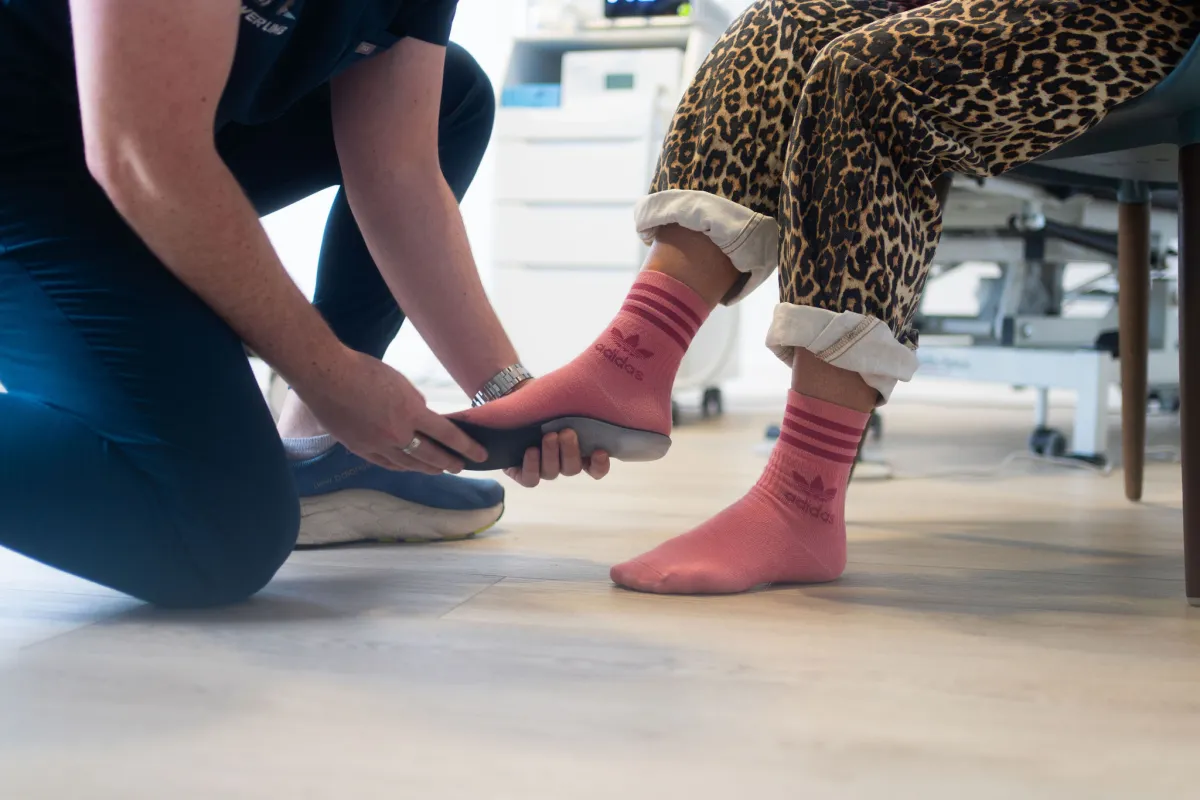
Podiatrist fitting a custom orthotic to a patient's foot at Lower Limb Clinic.
Common Causes & Risk Factors
Biomechanical
Excessive pronation, high rigid arches, tight calf muscles, reduced ankle dorsiflexion, weak intrinsic foot muscles, and leg length differences.
Activity-related
Sudden increases in walking, running, or standing; running on hard surfaces; inadequate footwear for your foot type.
Lifestyle
Higher body mass, occupations requiring prolonged standing (nursing, teaching, hospitality), and age-related tissue changes (most common 40–60 years).
What to Expect at Your First Appointment
You want answers and a plan — not another generic consultation. Here's exactly what happens:
Your story
5 minWe understand your experience: when it started, what makes it worse, what you've tried, and your goals.
Clinical examination
10 minHands-on assessment of feet, ankles, calves, and lower limb biomechanics — joint mobility, muscle strength, and pain reproduction.
Diagnostic ultrasound
10 minReal-time scanning of your plantar fascia — measuring thickness, tissue quality, tears, and blood flow. You see the screen as we scan.
Pressure plate analysis
10 minWalking analysis capturing loading patterns, weight distribution, and dynamic foot function.
Diagnosis & treatment plan
10 minClear diagnosis, written treatment plan, and — in most cases — your first treatment session on the same day.
Total appointment time: approximately 45 minutes (we book a full hour to allow for more complex cases). No GP referral needed. No waiting weeks for scan results.
Recovery Timeline
With our combined approach of accurate diagnosis, targeted therapy, and biomechanical correction, the majority of patients see significant improvement within 6–12 weeks.
Early intervention produces the best outcomes. Patients who present within the first few weeks typically recover in 6–8 weeks. Those who wait 6–12 months often require 3–6 months of treatment.
Your Clinician
Paul McMullan BSc(Hons) MSc FRCPSGlasg MRCPod leads the specialist heel pain service at Lower Limb Clinic. Paul holds a Master's degree in Podiatric Sports Medicine from Queen Mary University of London and is a Fellow of the Royal College of Physicians and Surgeons of Glasgow — one of very few podiatrists in Northern Ireland with this distinction. With over 15 years of clinical experience and advanced training in diagnostic ultrasound and biomechanical assessment, Paul brings MSc-level expertise to every consultation.
Darren Costello BSc(Hons) MSc MRCPSGlasg MRCPod also treats plantar fasciitis at Lower Limb Clinic. Darren holds an MSc in Sports & Exercise Medicine from Ulster University and is currently completing a CASE-certified ultrasound postgraduate course at Brunel University, London — bringing specialist musculoskeletal and diagnostic imaging skills to your assessment.
Why Patients Choose Lower Limb Clinic
Diagnostic ultrasound in every assessment
We confirm plantar fasciitis with ultrasound imaging — because not all heel pain is plantar fasciitis.
Pressure plate gait analysis as standard
We don't guess at your biomechanics. We measure them.
In-house orthotic manufacturing
Orthotics manufactured in our Réalta Labs using SLS 3D printing — faster turnaround, sub-millimetre precision.
MSc-level clinical expertise
Master's degree in Podiatric Sports Medicine and Fellowship of the Royal College of Physicians and Surgeons of Glasgow.
700+ five-star Google reviews
The highest-rated podiatry clinic in Northern Ireland.
Evidence-based treatment only
Every therapy we recommend has a robust evidence base supporting its use.
When Home Treatment Isn't Enough
If you've been managing heel pain at home for more than 4 weeks without meaningful improvement, the condition has likely progressed beyond what self-management can resolve. Chronic plantar fasciitis involves structural changes — thickening, architectural breakdown, and sometimes tears — that won't reverse with rest alone.
The longer plantar fasciitis goes untreated, the longer it takes to resolve. Early diagnosis genuinely makes a significant difference to outcomes.
Frequently Asked Questions
Common questions about Plantar Fasciitis at Lower Limb Clinic.
Find Your Nearest Clinic
Get Plantar Fasciitis at our clinic, conveniently located in East Belfast
Lisburn Road Clinic
385 Lisburn Road, BT9 7EP
Ormeau Road Clinic
373 Ormeau Road, BT7 3GP
Newcastle Clinic
1 Shimna Road, BT33 0AS
We serve patients from across Belfast and Northern Ireland including East Belfast, South Belfast, Lisburn, Bangor, Holywood, Newtownards, Dundonald, Carryduff, Hillsborough, and Comber.
Get Expert Treatment
- Same-week appointments available
- No GP referral needed
- MSc-qualified specialists
Related Conditions
Find Your Nearest Clinic
Get Plantar Fasciitis at our clinic, conveniently located in East Belfast
Lisburn Road Clinic
385 Lisburn Road, BT9 7EP
Ormeau Road Clinic
373 Ormeau Road, BT7 3GP
Newcastle Clinic
1 Shimna Road, BT33 0AS
We serve patients from across Belfast and Northern Ireland including East Belfast, South Belfast, Lisburn, Bangor, Holywood, Newtownards, Dundonald, Carryduff, Hillsborough, and Comber.